Byeong Chul Kim, President of Misung Commercial Co., Ltd.–08.
Chapter 8. A Growing Factory, Expanding Dreams
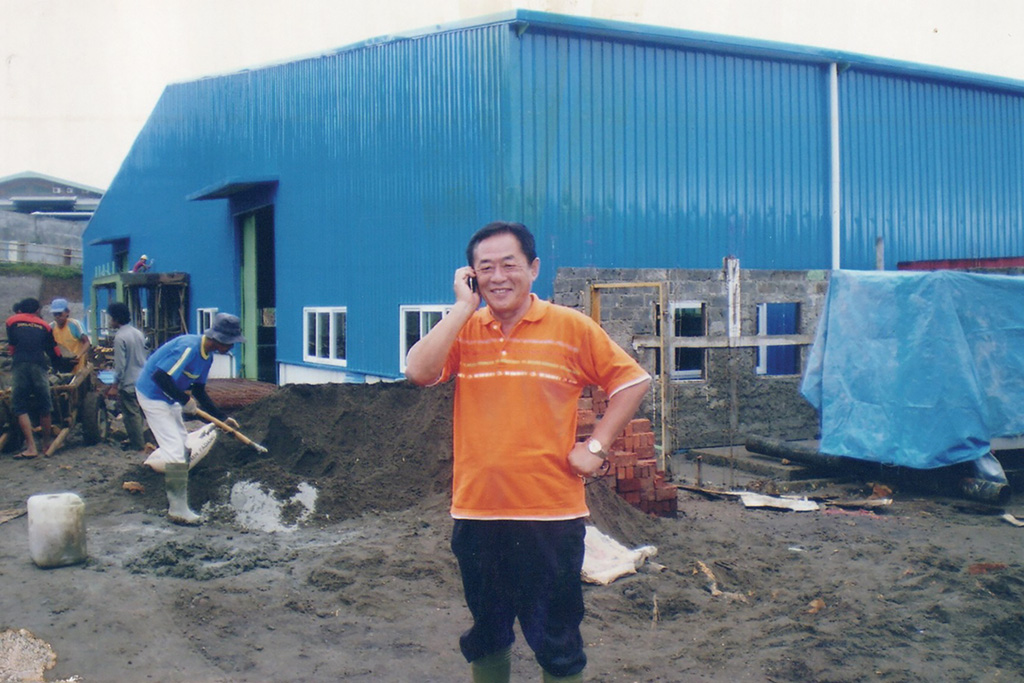
President Byeong Kim at the newly built Sukabumi factory.
Previous Story
[In 1983, President Byeong Chul Kim was dispatched to Senegal as part of Misung Commercial’s African expansion. Starting from bare land, he overcame countless challenges before successfully launching the ‘NINA’ hair brand. What was meant to be a one-year assignment stretched into ten. Just as he prepared to return to Korea, the company asked him to lead its Indonesian factory. Arriving in Jakarta in 1993, he embraced a new challenge—taking wig quality to the next level.]
The Dream of a Green Factory
As the company grew, I felt it was time to manage the factory’s appearance. I wanted visiting customers to see a place that radiated warmth and reliability, not a bleak concrete structure. I also hoped to instill pride in our employees, so they could feel, “Our factory looks far more impressive than others.”
The first step was painting. I chose green—a color of comfort and hope. The interior immediately felt brighter and calmer, and eye strain decreased. Outside, we planted broad-leaved trees for shade, rows of coconut palms and other palm trees suited to Indonesian soil, and several Royal Poinciana ‘Flame Trees’ I had admired since my time in Africa.
Within a few years, the once barren grounds had transformed into a tropical retreat, almost like a small resort. The KBN Industrial Complex administration recognized the change, selecting our factory multiple times as an ‘Outstanding Landscape Management Company’ and presenting commendations. It was a deeply rewarding experience.

The landscaping process played a major role in reshaping the factory’s image
Design•Development•Marketing: The Three Pillars of Growth
While enhancing the factory environment, we also began pursuing product differentiation. Because it was difficult to express Misung’s unique identity through raw fiber alone, we turned to the accessory cap—specifically the mesh, which formed the largest part of it. Traditionally, this inner mesh featured floral embroidery, known as the ‘flower mesh.’ We boldly replaced that pattern with the Misung logo.
Because the logo mesh was exclusive to Misung products, we had to place unusually large orders. Though somewhat burdensome, we pressed ahead with sample design and production through a trusted Korean factory. Early on, some buyers found the new mesh design unfamiliar.
“Why such an unusual design? Can’t you supply us with the traditional mesh?”
Still, we pushed forward, explaining our differentiation strategy. Within a few years, the Misung logo mesh was regarded as a mark of quality, and rival factories even tried to imitate it. This confirmed that Misung products had achieved wide recognition. We expanded the approach by applying logos to other parts, such as bands.
Around 2000, we acquired ‘Seogyung Printing’ to bring packaging production in-house and set up a design and graphics team that worked with buyers on promotional materials such as pamphlets and calendars. At the same time, we established ‘Iljinkwan,’ a facility with a wig development lab, showroom, and training room. During U.S. trips, lab staff accompanied the sales team to capture buyer and retail needs, feeding them directly into new product development.
As design, development, and marketing came into full alignment, the factory entered a period of revitalization within six to seven years. Every Misung product won acclaim in the U.S. market, and inquiries from new buyers surged.

Celebrating the opening of Iljinkwan (named after the company motto: Sincerity and Progress)
Fulfilling Demand at All Costs
The wig industry followed a unique cycle: four peak seasons—Easter, Thanksgiving, summer vacation, and Christmas—punctuated by low-demand periods. During peak times, shortages made delivery deadlines difficult to meet, while in off-seasons, orders dropped so sharply that factory operations struggled to continue. To address this, discussions began on introducing a two-shift system to run the factory day and night.
Keeping the factory running at full capacity, day and night, was no small challenge. Rather than dwelling on why it might not work, we agreed to give it a try. That decision set everything in motion—sitting down with hesitant employees one by one, explaining our vision, and encouraging them to come on board.
The toughest challenge came from the sewing machine technicians, who treated their machines as personal property. To ease their concerns, the company pledged to replace any broken machines and compensate for lost productivity. After much effort, the two-shift system gradually took root. Although night-shift output was lower, overall production and on-time delivery improved dramatically, enabling the factory to consistently meet customer demand. In the end, we came to run the entire factory in two shifts.
Mr. President, Who Never Sleeps
Because the factory operated day and night, I felt it was my duty to show my face to employees, even during the night shift. After finishing work and getting a few hours of rest, I often returned to the factory. Entering the industrial complex, the sight of our brightly lit building filled me with pride.
As I made my rounds, exchanging winks and greetings with the night shift workers, I felt a deep sense of responsibility—after all, nearly 2,000 employees in one factory meant 4,000 eyes were watching me.
Before long, a rumor spread: ‘Mr. President has insomnia. That’s why he comes to the factory at night.’ In truth, I could fall asleep the moment my head hit the pillow, but I didn’t mind the story. Looking back now, it still makes me smile.
Mr. President, Can We Have Overtime at the Outing Too?
To encourage our staff, we organized large outings. Over 2,000 employees, divided by department, boarded more than 40 tour buses bound for a beach two hours away, escorted by police motorcycles.
Local entertainers performed, and we held singing contests, games, and an awards ceremony. The employees looked as though they were having a wonderful time. Many employees, used only to commuting between home and the factory, had never imagined visiting such a distant beach. When it was time to leave, they were unwilling to leave.
One even joked, “When the factory is busy you make us work overtime—can’t we have overtime at the outing too?”
Managing 40 tour buses at night was no small feat. After much coaxing, we promised another outing in the future, and everyone boarded the buses home.

Factory workers enjoying the company picnic with great excitement.
Flood Damage and Factory Expansion
In February 2007, record-breaking floods submerged the entire industrial complex, the water rising to an adult’s waist. Situated in a coastal lowland, the complex had always been vulnerable to poor drainage during heavy rains. Vehicle access was cut off, and people had to cross using makeshift rafts—planks laid across empty drums.
Everything—raw materials, components, finished products—was lost. Only items placed higher, like sewing machines, could be salvaged. Natural disasters are unavoidable, but the kindness of American buyers, who sent condolence funds and extended delivery deadlines after hearing of the damage, was a deeply moving show of humanity.
In the aftermath, we resolved to expand. Wig production facilities were added at another site within the same industrial complex, staffed and operated as a second factory. Soon after, a third factory was established in the Sukabumi region. For a time, employees rotated between the first, second, and third wig factories.

The KBN Industrial Complex submerged by floodwaters.

We used large tubs to reach the flooded factory.
< Continued in the next issue>